Showing posts with label Books. Show all posts

Sunday, June 8, 2014

The Lion's Roar: An Introduction to Tantra (Extract From Chapter Six )


Extract From Chapter Six - Alpha Pure

http://www.amazon.co.uk/gp/product/1570628955/ref=as_li_ss_tl?ie=UTF8&camp=1634&creative=19450&creativeASIN=1570628955&linkCode=as2&tag=freuquot-21
As we said at the beginning, the journey through the nine yanas is a process of rediscovering oneself. As you move along the path, you have a feeling of particular locations. You are traveling through a dense forest or through heavy snow; you are climbing mountains or crossing fields; you encounter rainstorms and snowstorms. You have to stop each night to eat and sleep, and so on. All those experiences make up your journey. In a sense we could say that the rainstorms are your rainstorms, the snowstorms are your snow-storms, and the dense forests are your dense forests. It's your world. As you move through the nine yanas, it is yourself that you are rediscovering -more and more clearly.

At the beginning there is a vague idea that something is not quite right. There is something wrong with oneself. Things are questionable, and one begins to look into the question, to relate with the pain, the chaos and confusion. That is the hinayana level. Then at a certain stage some of the answers that arise out of the search begin to create further hunger, further curiosity. One~ heart becomes more and more steeped in the teachings. Then the mahayana experience of intense dedication to the path begins to take place. Dedication to the path in this case also means compassion, a loving attitude toward oneself and others. One begins to find one's place in the universe, in this world. Being on the bodhisattva path is finding one's place and one's sense of dedication in this universe. At that point, the universe is not threatening or irritating anymore. This is time for the very simple reason that one has developed a style for working with the universe; meditation in action has begun to develop.
As you go on then, you rediscover the brand-new world of tantra. An enormous surprise takes place. You recognize the magical aspect of the universe, which means yourself as well as everything else. You rediscover the redness of red, the blueness of blue, the whiteness of white, and so on. You rediscover the meaning of passion and the meaning of aggression, their vividness, their alive-ness, and also their transcendental quality. Rediscovering this new world is the vajrayana path.

At that point, not only do you realize the meaning of pain and confusion, and not only do you realize you have a place in the world, but you also develop a sense of dignity. In fact, you are the emperor of the universe, the king of the world. Your sense of dignity is related to the experience that you have an enormous place in this world. In fact, you are the maker of the world.

As the tantric experience develops through the lower tantras to the higher tantras, even the notion of being the emperor of the universe becomes unnecessary. You are the universe. You have no reference point, none at all. Everything is on the level of complete oneness. In higher tantric terms, this is known in Tibetan as kadak. Ka is the first letter of the Tibetan alphabet, dak means pure. So it means "pure right at the beginning," or you might say "alpha pure." Purity in this case has nothing to do with the relative reference point of pure as opposed to impure. Purity here has the sense of being really without comparison to anything, without any relative reference at all. That seems to be the state of development we are working toward. That, finally, is the level of the maha ati teachings, in which there is no reference point, none whatsoever. Therefore, in that state we find millions of reference points everywhere, which do not conflict with each other. Therefore we become precise and open, very general and very specific at the same time. That is the state of enlightenment, if it can be described at all in words. That's a sort of finger painting of the enlightenment idea.

The whole journey that we have discussed has its roots in overcoming spiritual materialism to begin with, then developing friendship toward oneself and others, and finally developing vajra pride, or a sense of dignity.1 Those three steps are the general guidelines for the hinayana, mahayana, and vajrayana, or tantra. And those experiences cannot come about without a teacher or master to begin with, on the hinayana level; a spiritual friend who minds one's business intensely on the bodhisattva or mahayana level; or, on the vajrayana level, a vajra master or vajra guru, who holds one's life strings in his hand.

There is a story about the abhisheka that the great tantric master Padmasambhava received from Shri Simha, the great sage of maha ati. Shri Simha reduced Padmasambhava to the form of the letter HUM. Then he ate it, he put it in his mouth and swallowed it. And when Padmasambhava came out the other end of Shri Simha, that completed his abhisheka. This is an example of the action of the vajra master. He is more than a teacher alone, more than a spiritual friend. The vajra master eats you up and shits you out, having completely processed you in his vajra body. That is the kind of power we're talking about. Without such a relationship, without this kind of communication, vajrayana cannot be presented. Without this, one cannot even come near to under. standing it. So relationships with the various levels of teacher are definitely requirements for progressing on the path.

Then, of course, there is the practice of meditation, which is another important part of the journey. One must practice meditation on the hinayana level in order to develop the basic sanity of relating to one's mind as a working basis. The satipatthana methods of mindfulness developed in the Theravada tradition are very powerful and important. The methods developed in the Sarvastivadin hinayana tradition that exists in Tibet, Japan, and China are identical.

When I was in India, I discussed meditation techniques for awareness practice with a Burmese master who was the disciple of a very great Burmese meditation teacher. When I told him about the vipashyana meditation technique that we used in Tibet, he shook his head and asked me, "When did you go to Burma?" So the methods seem to be identical.

It is necessary to begin at the beginning with the hinayana practice. Without that, we do not develop proper sense perception, so to speak. We have to have good eyesight and good hearing to read and listen to the teachings. And we have to have a good body in order to sit and meditate. Good sense perceptions here mean sense perceptions that are no longer distorted. We can have real understanding, no longer distorted by neurosis. That is absolutely necessary; there's no other way at all, according to Buddha anyway.

Having that solid rock bed for a foundation, that solid, sane, open, fresh ground, you can begin to build, to put up walls. That corresponds to the mahayana discipline of the six paramitas and friendliness to oneself and others. This gives us a sense of direction about how to act as good citizens, which is the bodhisattva path. After one has become a good citizen, there is an enormous possibility of becoming a genius. Basic sanity has developed and a proper lifestyle has been established. There are no hassles, no obstacles at all. Then you become a genius, which is the vajrayana level.

You become a fantastic artist, musician, sculptor, or poet. You begin to see the workings of the universe in its ultimate, last details. You are such a genius that you see everything completely. That's the final level.
This genius is described as jnana, wisdom. There are five types of genius, five wisdoms. There is mirrorlike wisdom, which is clarity. There is the wisdom of equality, which is seeing everything!~ at once in a panoramic vision. There is the wisdom of discriminating awareness, which is seeing details on an ultimately precise level. There is the wisdom of all-accomplishing action, in which speed does not have to be included in one's working situation, but things fall into your pattern. Then there is the fifth wisdom, the wisdom of dharmadhatu, or all-encompassing space, which develops enormous basic sanity and basic spaciousness in the sense of outer space rather than space that is related to the reference point of any planet. That is the kind of cosmic level of genius that we find in the vajrayana.

I suppose this seminar cannot be any more than a teaser for you. But at least you should know that millions of great people have been produced by this path; and not only have they been produced, but they all say the same thing. They've all gone through the same process that is being presented here. And we are not excluded from the possibility of becoming one of them. According to the Buddha, one out of every four people in the sangha becomes enlightened.

What we have done very roughly in this seminar has been to give a complete description of the path from the beginning stages to enlightenment. I hope you will have a sense of aspiration and feel joyful about what we discussed. The other possibility is that you might feel depressed, because you have heard about so many possibilities and good things, but none of them seem to apply to you. Well, okay, be that way-and use your depression as realization of the truth of suffering. Then you will have accomplished the first step already. Or if you are inspired, then buddha fever, the fever of buddha nature, has already possessed you. So let it be that way. It seems that whatever we do, we can't go wrong.

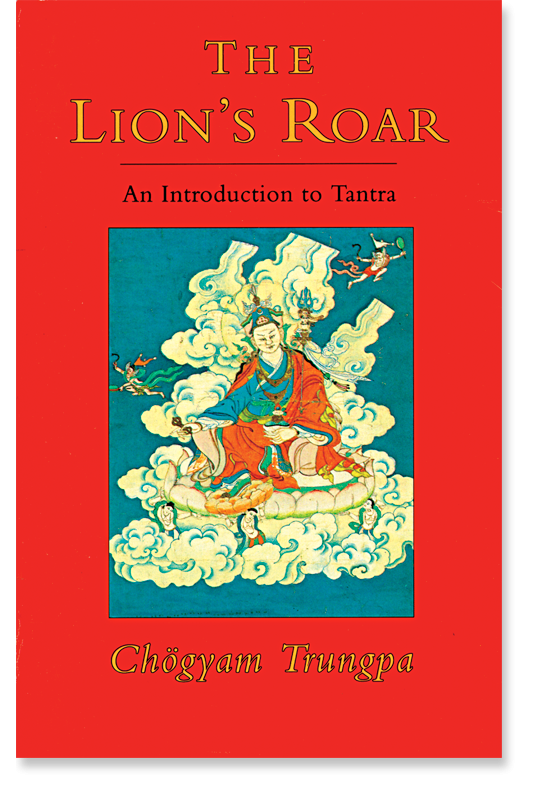
Chogyam Trungpa - The Lion's Roar: An Introduction to Tantra


http://www.amazon.co.uk/gp/product/1570628955/ref=as_li_ss_tl?ie=UTF8&camp=1634&creative=19450&creativeASIN=1570628955&linkCode=as2&tag=freuquot-21
This book is based on two historic seminars of the 1970s, in which Chögyam Trungpa introduced the tantric teachings of Tibetan Buddhism to his Western students for the first time. Each seminar bore the title "The Nine Yanas." Yana, a Sanskrit word meaning "vehicle," refers to a body of doctrine and practical instruction that enables students to advance spiritually on the path of Buddha-dharma. Nine vehicles, arranged in successive levels, make up the whole path of Buddhist practice. Teaching all nine means giving a total picture of the spiritual journey. The author's nontheoretical, experiential approach opens up a world of fundamental psychological insights and subtleties. He speaks directly to a contemporary Western audience, using earthly analogies that place the ancient teachings in the midst of ordinary life.


Chogyam Trungpa - The Dawn of Tantra


http://www.amazon.co.uk/gp/product/B00EYGHMXY/ref=as_li_ss_tl?ie=UTF8&camp=1634&creative=19450&creativeASIN=B00EYGHMXY&linkCode=as2&tag=freuquot-21
Westerners wanting to know about tantra—particularly the Buddhist tantra of Tibet—often find only speculation and fancy. Tibet has been shrouded in mystery, and "tantra" has been called upon to name every kind of esoteric fantasy. In The Dawn of Tantra the reader meets a Tibetan meditation master and a Western scholar, each of whose grasp of Buddhist tantra is real and unquestionable. This collaboration is both true to the intent of the ancient Tibetan teachings and relevant to contemporary Western life.


Chogyam Trungpa - Glimpses of Abhidharma: From a Seminar on Buddhist Psychology


http://www.amazon.co.uk/gp/product/1570627649/ref=as_li_ss_tl?ie=UTF8&camp=1634&creative=19450&creativeASIN=1570627649&linkCode=as2&tag=freuquot-21
The Abhidharma is a collection of Buddhist scriptures that investigate the workings of the mind and the states of human consciousness. In this book, Chögyam Trungpa shows how an examination of the formation of the ego provides us with an opportunity to develop real intelligence. Trungpa also presents the practice of meditation as the means that enables us to see our psychological situation clearly and directly.


Chogyam Trungpa - Training the Mind and Cultivating Loving-Kindness


http://www.amazon.co.uk/gp/product/1590302524/ref=as_li_ss_tl?ie=UTF8&camp=1634&creative=19450&creativeASIN=1590302524&linkCode=as2&tag=freuquot-21
The slogans contained in this book are designed to awaken the heart and cultivate love and kindness toward others. They are revolutionary in that practicing them fosters abandonment of personal territory in relating to others and an understanding of the world as it is.

The fifty-nine provocative slogans presented here—each with a commentary by the Tibetan meditation master Chögyam Trungpa—have been used by Tibetan Buddhists for eight centuries to help meditation students remember and focus on important principles and practices of mind training. They emphasize meeting the ordinary situations of life with intelligence and compassion under all circumstances. Slogans include, "Don't be swayed by external circumstances," "Be grateful to everyone," and "Always maintain only a joyful mind."

This edition contains a foreword by Pema Chödrön.


Chogyam Trungpa - Illusion's Game: The Life and Teaching of Naropa


http://www.amazon.co.uk/gp/product/0877738572/ref=as_li_ss_tl?ie=UTF8&camp=1634&creative=19450&creativeASIN=0877738572&linkCode=as2&tag=freuquot-21
In what he calls a "200 percent potent" teaching, Chogyam Trungpa reveals how the spiritual path is a raw and rugged "unlearning" process that draws us away from the comfort of conventional expectations and conceptual attitudes toward a naked encounter with reality. The tantric paradigm for this process is the story of the Indian master Naropa (1016–1100), who is among the enlightened teachers of the Kagyu lineage of the Tibetan Buddhism. Naropa was the leading scholar at Nalanda, the Buddhist monastic university, when he embarked upon the lonely and arduous path to enlightenment. After a series of daunting trials, he was prepared to receive the direct transmission of the awakened state of mind from his guru, Tilopa. Teachings that he received, including those known as the six doctrines of Naropa, have been passed down in the lineages of Tibetan Buddhism for a millennium.

Trungpa's commentary shows the relevance of Naropa's extraordinary journey for today's practitioners who seek to follow the spiritual path. Naropa's story makes it possible to delineate in very concrete terms the various levels of spiritual development that lead to the student's readiness to meet the teacher's mind. Trungpa thus opens to Western students of Buddhism the path of devotion and surrender to the guru as the embodiment and representative of reality.


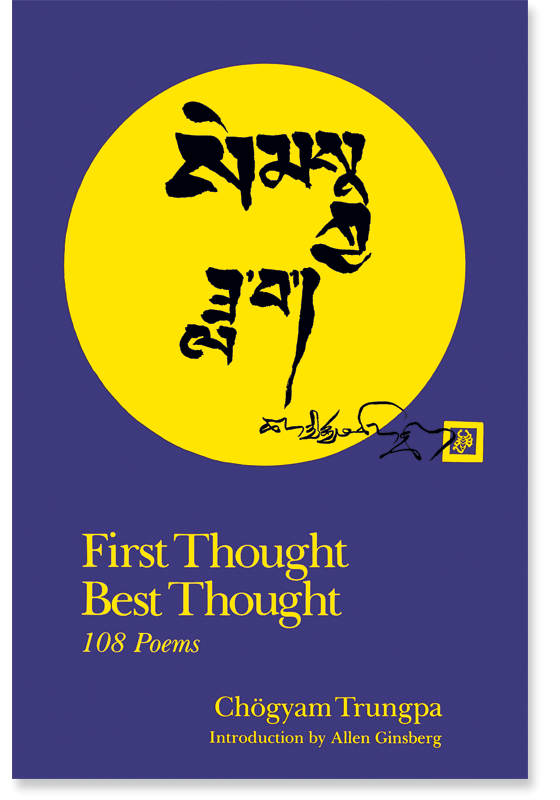
Chogyam Trungpa - First Thought, Best Thought: 108 Poems


http://www.amazon.co.uk/gp/product/B00HEN3IYQ/ref=as_li_ss_tl?ie=UTF8&camp=1634&creative=19450&creativeASIN=B00HEN3IYQ&linkCode=as2&tag=freuquot-21
Here is a unique contribution to the field of poetry: a new collection of works by America's foremost Buddhist meditation master, Chögyam Trungpa. These poems and songs—most of which were written since his arrival in the United States in 1970—combine a background in classical Tibetan poetry with Trungpa's intuitive insight into the spirit of America, a spirit that is powerfully evoked in his use of colloquial metaphor and contemporary imagery.

Most of the poems were originally written in English—clearly the result of the author's own perceptions of new forms and media offered to him by a different culture. Each poem has its own insight and power, which come from a skillful blend of traditional Asian subtlety and precision combined with a thoroughly modern vernacular. Several of the author's calligraphies accompany the collection.


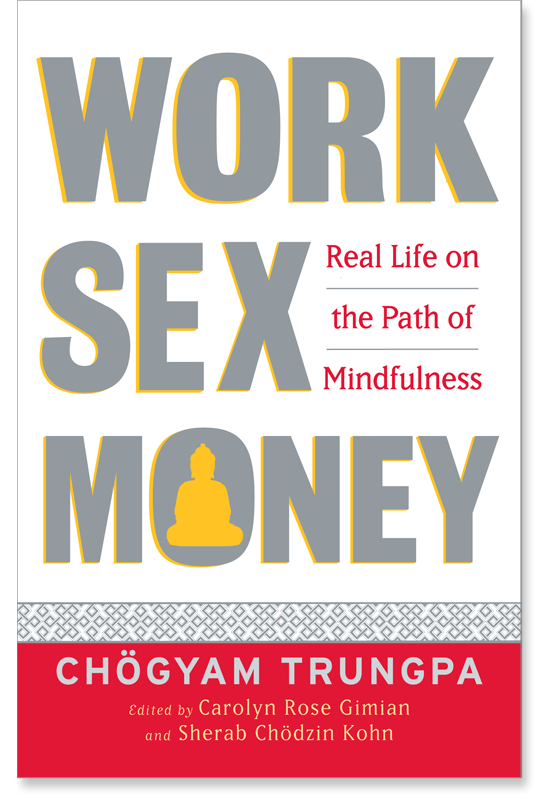
Chogyam Trungpa - Work, Sex, Money: Real Life on the Path of Mindfulness


Each day we deal with the challenges of ordinary life: a series of mundane experiences that could be summarized by the title of this book, Work, Sex, Money. We all hope that these aspects of our life will be a source of fulfillment and pleasure, and they often are. Yet they are also always sources of problems for which we seek practical advice and solutions. The best prescription, according to Chögyam Trungpa, is a dose of reality and also a dose of respect for ourselves and our world. His profound teachings on work, sex, and money celebrate the sacredness of life and our ability to cope with its twists and turns with dignity, humor, and even joy.

http://www.amazon.co.uk/gp/product/1590305965/ref=as_li_ss_tl?ie=UTF8&camp=1634&creative=19450&creativeASIN=1590305965&linkCode=as2&tag=freuquot-21
He begins by breaking down the barrier between the spiritual and the mundane, showing that work, sex, and money are just as much a part of our spiritual life as they are a part of our everyday existence. He then discusses these subjects in relation to ego and self-image, karma, mindfulness, and meditation. “Work” includes general principles of mindfulness and awareness in how we conduct everyday life as well as discussion of ethics in business and the workplace. “Sex” is about relationships and communication as a whole. “Money” looks at how we view the economics of livelihood and money as “green energy” that affects our lives. The result is an inclusive vision of life, one that encompasses the biggest issues and the smallest details of every day.

There are, in fact, few definitive answers in these pages. There is, however, authentic wisdom providing us with tools we need to work with the toughest stuff in our lives.

"Chögyam Trungpa shows us how to uncover our innate strength, confidence, and joy under any circumstances." — Pema Chödrön


The Pocket Chogyam Trungpa


http://www.amazon.co.uk/gp/product/1590306430/ref=as_li_ss_tl?ie=UTF8&camp=1634&creative=19450&creativeASIN=1590306430&linkCode=as2&tag=freuquot-21
Here is a treasury of 108 short teachings by Chögyam Trungpa, one of the most influential Buddhist teachers of our time. Pithy and immediate, these teachings address a range of topics, including fear and fearlessness, accepting our imperfections, developing confidence, helping others, appreciating our basic goodness, and everyday life as a spiritual path.


Chogyam Trungpa - Born in Tibet


http://www.amazon.co.uk/gp/product/1570627142/ref=as_li_ss_tl?ie=UTF8&camp=1634&creative=19450&creativeASIN=1570627142&linkCode=as2&tag=freuquot-21
Chögyam Trungpa—meditation master, scholar, and artist—was identified at the age of only thirteen months as a major tulku, or reincarnation of an enlightened teacher. As the eleventh in the teaching lineage known as the Trungpa tulkus, he underwent a period of intensive training in mediation, philosophy, and fine arts, receiving full ordination as a monk in 1958 at the age of eighteen. The following year, the Chinese Communists invaded Tibet, and the young Trungpa spent many harrowing months trekking over the Himalayas, narrowly escaping capture.

Trungpa's account of his experiences as a young monk, his duties as the abbot and spiritual head of a great monastery, and his moving relationships with his teachers offers a rare and intimate glimpse into the life of a Tibetan lama. The memoir concludes with his daring escape from Tibet to India. In an epilogue, he describes his emigration to the West, where he encountered many people eager to learn about the ancient wisdom of Tibetan Buddhism.

Chogyam Trungpa - The Heart of the Buddha: Entering the Tibetan Buddhist Path


http://www.amazon.co.uk/gp/product/1590304519/ref=as_li_ss_tl?ie=UTF8&camp=1634&creative=19450&creativeASIN=1590304519&linkCode=as2&tag=freuquot-21
In The Heart of the Buddha, the Tibetan meditation master Chögyam Trungpa presents the basic teachings of Buddhism as they relate to everyday life. The book is divided into three parts. In “Personal Journey,” the author discusses the open, inquisitive, and good-humored qualities of the “heart of the Buddha,” an “enlightened gene” that everyone possesses. In “Stages on the Path,” he presents the three vehicles—Hinayana, Mahayana, and Vajrayana—that carry the Buddhist practitioner toward enlightenment. In “Working with Others,” he describes the direct application of Buddhist teachings to topics as varied as relationships, drinking, children, and money. The Heart of the Buddha reflects Trungpa’s great appreciation for Western culture and deep understanding of the Tibetan Buddhist tradition, which enabled him to teach Westerners in an effective, contemporary way.


Chogyam Trungpa - Shambhala: The Sacred Path of the Warrior


http://www.amazon.co.uk/gp/product/1590304519/ref=as_li_ss_tl?ie=UTF8&camp=1634&creative=19450&creativeASIN=1590304519&linkCode=as2&tag=freuquot-21
There is a basic human wisdom that can help solve the world’s problems. It doesn’t belong to any one culture or region or religious tradition—though it can be found in many of them throughout history. It’s what Chögyam Trungpa called the sacred path of the warrior. The sacred warrior conquers the world not through violence or aggression, but through gentleness, courage, and self-knowledge. The warrior discovers the basic goodness of human life and radiates that goodness out into the world for the peace and sanity of others. That’s what the Shambhala teachings are all about, and this is the book that has been presenting them to a wide and appreciative audience for more than twenty years.


Chogyam Trungpa - The Myth of Freedom and the Way of Meditation


http://www.amazon.co.uk/gp/product/1590302893/ref=as_li_ss_tl?ie=UTF8&camp=1634&creative=19450&creativeASIN=1590302893&linkCode=as2&tag=freuquot-21
Freedom is generally thought of as the ability to achieve goals and satisfy desires. But what are the sources of these goals and desires? If they arise from ignorance, habitual patterns, and negative emotions, is the freedom to pursue these goals true freedom—or is it just a myth?

Chögyam Trungpa's unique ability to express the essence of Buddhist teachings in the language and imagery of modern American culture makes his books among the most accessible works of Buddhist philosophy. Here Trungpa explores the true meaning of freedom, showing us how our preconceptions, attitudes, and even our spiritual practices can become chains that bind us to repetitive patterns of frustration and despair. This edition features a new foreword by Pema Chödrön, a close student of Trungpa and the best-selling author of When Things Fall Apart.


Chogyam Trungpa - The Truth of Suffering and the Path of Liberation


http://www.amazon.co.uk/gp/product/1590307704/ref=as_li_ss_tl?ie=UTF8&camp=1634&creative=19450&creativeASIN=1590307704&linkCode=as2&tag=freuquot-21
The truth of life has never been better or more succinctly articulated than in the Buddha's teaching on suffering, its cause, and its cessation—the famous formulation known as the Four Noble Truths. This concise handful of words is in fact the foundation from which all subsequent Buddhist teachings grow, and upon which all of them rely. Their wisdom is as pertinent to the scholar of Buddhist philosophy as it is to the ordinary practitioner, as it is indeed to anyone, anywhere, who aspires to liberation.

Chögyam Trungpa's in-depth exploration of the Four Noble Truths reveals the subtlety and sophistication that lie beneath these deceptively simple teachings. He emphasizes their profound relevance not just as an inspiration when we set out on the path but at every other moment of our lives as well, showing how we can join view (intellectual understanding) of the teaching with practical application in order to interrupt suffering before it arises.

His teaching is, as always, refreshingly direct and profoundly inspiring. The Truth of Suffering is an ideal introduction to the Four Noble Truths for the beginner as well as for the experienced practitioner in search of deeper understanding.

Chogyam Trungpa - Cutting Through Spiritual Materialism


http://www.amazon.co.uk/gp/product/1570629579/ref=as_li_ss_tl?ie=UTF8&camp=1634&creative=19450&creativeASIN=1570629579&linkCode=as2&tag=freuquot-21
In this modern spiritual classic, the Tibetan meditation master Chögyam Trungpa highlights the commonest pitfall to which every aspirant on the spiritual path falls prey: what he calls spiritual materialism. The universal tendency, he shows, is to see spirituality as a process of self-improvement—the impulse to develop and refine the ego when the ego is, by nature, essentially empty. "The problem is that ego can convert anything to its own use," he said, "even spirituality." His incisive, compassionate teachings serve to wake us up from this trick we all play on ourselves, and to offer us a far brighter reality: the true and joyous liberation that inevitably involves letting go of the self rather than working to improve it. It is a message that has resonated with students for nearly thirty years, and remains fresh as ever today.

This new edition includes a foreword by Chögyam Trungpa's son and lineage holder, Sakyong Mipham.


Saturday, June 7, 2014

Pema Chodron Quotes - How to Meditate: A Practical Guide to Making Friends with Your Mind


http://www.amazon.co.uk/gp/product/1604079339/ref=as_li_ss_tl?ie=UTF8&camp=1634&creative=19450&creativeASIN=1604079339&linkCode=as2&tag=freuquot-21
“No … big … deal.” He wasn’t saying “bad,” and he wasn’t saying “good.” He was saying that these things happen and they can transform your life, but at the same time don’t make too big a deal of them, because that leads to arrogance and pride, or a sense of specialness. On the other hand, making too big a deal about your difficulties takes you in the other direction; it takes you into poverty, self-denigration, and a low opinion of yourself.”
― Pema Chödrön, How to Meditate: A Practical Guide to Making Friends with Your Mind

“In other words, you could endlessly try to have suffering cease by dealing with outer circumstances—and that’s usually what all of us do. It is the usual approach; you just try to solve the outer problem again and again and again. But the Buddha said something quite revolutionary, which most of us don’t really buy: if you work with your mind, you will alleviate all the suffering that seems to come from the outside. When something is bothering you—a person is bugging you, a situation is irritating you, or physical pain is troubling you—you must work with your mind, and that is done through meditation. Working with our minds is the only means through which we’ll actually begin to feel happy and contented with the world that we live in.”
― Pema Chödrön, How to Meditate: A Practical Guide to Making Friends with Your Mind

“The principle of nowness is very important to any effort to establish an enlightened society. You may wonder what the best approach is to helping society and how you can know that what you are doing is authentic and good. The only answer is nowness. The way to relax, or rest the mind in nowness, is through the practice of meditation. In meditation you take an unbiased approach. You let things be as they are, without judgment, and in that way you yourself learn to be. —CHÖGYAM TRUNGPA RINPOCHE”
― Pema Chödrön, How to Meditate: A Practical Guide to Making Friends with Your Mind

“The principle of nowness is very important to any effort to establish an enlightened society.”
― Pema Chödrön, How to Meditate: A Practical Guide to Making Friends with Your Mind


Friday, June 6, 2014

Pema Chodron Quotes - No Time to Lose: A Timely Guide to the Way of the Bodhisattva


“In order to work with difficult outer circumstances, we need to gather our inner strength. If even ten or twenty minutes of meditation a day helps us to do this, let's go for it!”
― Pema Chödrön, No Time to Lose: A Timely Guide to the Way of the Bodhisattva

“Making good use of our limited time - the limited time from birth to death, as well as our limited time each day - is the key to developing inner steadiness and calm.”
― Pema Chödrön, No Time to Lose: A Timely Guide to the Way of the Bodhisattva


Pema Chodron Quotes - Taking the Leap: Freeing Ourselves from Old Habits and Fears


http://www.amazon.co.uk/gp/product/1590308433/ref=as_li_ss_tl?ie=UTF8&camp=1634&creative=19450&creativeASIN=1590308433&linkCode=as2&tag=freuquot-21
“Words themselves are neutral. It's the charge we add to them that matters”
― Pema Chödrön, Taking the Leap: Freeing Ourselves from Old Habits and Fears

“A Native American grandfather was speaking to his grandson about violence and cruelty in the world and how it comes about. He said it was as if two wolves were fighting in his heart. One wolf was vengeful and angry, and the other wolf was understanding and kind. The young man asked his grandfather which wolf would win the fight in his heart. And the grandfather answered, “The one that wins will be the one I choose to feed.”
― Pema Chödrön, Taking the Leap: Freeing Ourselves from Old Habits and Fears

“When things fall apart and we can’t get the pieces back together, when we lose something dear to us, when they whole thing is just not working and we don’t know what to do, this is the time when the natural warmth of tenderness, the warmth of empathy and kindness, are just waiting to be uncovered, just waiting to be embraced. This is our chance to come out of our self-protecting bubble and to realize that we are never alone. This is our chance to finally understand that wherever we go, everyone we meet is essentially just like us. Our own suffering, if we turn toward it, can open us to a loving relationship with the world.”
― Pema Chödrön, Taking the Leap: Freeing Ourselves from Old Habits and Fears

“Whether we’re seeking inner peace or global peace or a combination of the two, the way to experience it is to build on the foundation of unconditional openness to all that arises. Peace isn’t an experience free of challenges, free of rough and smooth, it’s an experience that’s expansive enough to include all that arises without feeling threatened.”
― Pema Chödrön, Taking the Leap: Freeing Ourselves from Old Habits and Fears

“When we feel dread, when we feel discomfort of any kind, it can connect us at the heart with all the other people feeling dread and discomfort. We can pause and touch into dread. We can touch bitterness of rejection and the rawness of being slighted. Whether we are at home or in a public spot or caught in a traffic jam or walking into a movie, we can stop and look at the other people there and realize that in pain and in joy they are just like me. Just like me they don’t want to feel physical pain or insecurity or rejection. Just like me they want to feel respected and physically comfortable.”
― Pema Chödrön, Taking the Leap: Freeing Ourselves from Old Habits and Fears


http://www.amazon.co.uk/gp/product/1590308433/ref=as_li_ss_tl?ie=UTF8&camp=1634&creative=19450&creativeASIN=1590308433&linkCode=as2&tag=freuquot-21


Pema Chodron Quotes - Comfortable with Uncertainty: 108 Teachings on Cultivating Fearlessness and Compassion


http://www.amazon.co.uk/gp/product/1590300785/ref=as_li_ss_tl?ie=UTF8&camp=1634&creative=19450&creativeASIN=1590300785&linkCode=as2&tag=freuquot-21
“Nothing ever goes away until it has taught us what we need to know.”
― Pema Chödrön, Comfortable with Uncertainty: 108 Teachings on Cultivating Fearlessness and Compassion

“There was once a lady who was arrogant and proud. Determined to attain enlightenment, she asked all the authorities how to go about it. She was told, "Well, if you climb to the top of this very high mountain, you'll find a cave there. Sitting inside that cave is a wise old woman. She will tell you." Having endured great hardships, the lady finally found this cave. Sure enough, sitting there was a gentle spiritual-looking old woman in white clothing, who smiled beatifically. Overcome with awe and respect, the lady prostrated at the feet of this woman and said, "I want to attain enlightenment. Show me how." This wise woman looked at her and asked sweetly, "Are you sure you want to attain enlightenment?" And the woman said, "Of course I'm sure." Whereupon the smiling woman turned into a demon, stood up brandishing a great big stick, and started chasing her, saying, "Now! Now! Now!" For the rest of her life, that lady could never get away from the demon who was always saying, Now! Now--that's the key. Mindfulness trains us to be awake and alive, fully curious, about now.”
― Pema Chödrön, Comfortable with Uncertainty: 108 Teachings on Cultivating Fearlessness and Compassion

“Be grateful to everyone" is about making peace with the aspects of ourselves that we have rejected... If we were to make a list of people we don't like - people we find obnoxious, threatening, or worthy of contempt - we would discover much about those aspects of ourselves that we can't face... other people trigger the karma that we haven't worked out.”
― Pema Chödrön, Comfortable with Uncertainty: 108 Teachings on Cultivating Fearlessness and Compassion

“Nothing in its essence is one way or the other.”
― Pema Chödrön, Comfortable with Uncertainty: 108 Teachings on Cultivating Fearlessness and Compassion

“There are many changes in the weather of a day.”
― Pema Chödrön, Comfortable with Uncertainty: 108 Teachings on Cultivating Fearlessness and Compassion

“Pain is not a punishment, pleasure is not a reward.”
― Pema Chödrön, Comfortable with Uncertainty: 108 Teachings on Cultivating Fearlessness and Compassion

“Our habitual patterns are, of course, well established, seductive, and comforting. Just wishing for them to be ventilated isn’t enough. Mindfulness and awareness are key. Do we see the stories that we’re telling ourselves and question their validity? When we are distracted by a strong emotion, do we remember that it is part of our path? Can we feel the emotion and breathe it into our hearts for ourselves and everyone else? If we can remember to experiment like this even occasionally, we are training as a warrior. And when we can’t practice when distracted but know that we can’t, we are still training well. Never underestimate the power of compassionately recognizing what’s going on.”
― Pema Chödrön, Comfortable with Uncertainty: 108 Teachings on Cultivating Fearlessness and Compassion

“Patience is not learned in safety.”
― Pema Chödrön, Comfortable with Uncertainty: 108 Teachings on Cultivating Fearlessness and Compassion

“Without loving-kindness, staying in pain is just warfare.”
― Pema Chödrön, Comfortable with Uncertainty: 108 Teachings on Cultivating Fearlessness and Compassion

“Fear is a natural reaction of moving closer to the truth.”
― Pema Chödrön, Comfortable with Uncertainty: 108 Teachings on Cultivating Fearlessness and Compassion

“What you do for yourself, any gesture of kindness, any gesture of gentleness, any gesture of honesty and clear seeing toward yourself, will affect how you experience your world. In fact, it will transform how you experience the world. What you do for yourself, you’re doing for others, and what you do for others, you’re doing for yourself.”
― Pema Chödrön, Comfortable with Uncertainty: 108 Teachings on Cultivating Fearlessness and Compassion

“I take refuge in the Buddha,” that means I take refuge in the courage and the potential of fearlessness, of removing all the armor that covers this awakeness of mine. I am awake; I will spend my life taking this armor off. Nobody else can take it off because nobody else knows where all the little locks are, nobody else knows where it’s sewed up tight, where it’s going to take a lot of work to get that particular iron thread untied.”
― Pema Chödrön, Comfortable with Uncertainty: 108 Teachings on Cultivating Fearlessness and Compassion

“LEARNING HOW to be kind to ourselves is important. When we look into our own hearts and begin to discover what is confused and what is brilliant, what is bitter and what is sweet, it isn’t just ourselves that we’re discovering. We’re discovering the universe.”
― Pema Chödrön, Comfortable with Uncertainty: 108 Teachings on Cultivating Fearlessness and Compassion

“it’s good to express our gratitude to others. It’s helpful to express our appreciation of others. But if we do that with the motivation of wanting them to like us, we can remember this slogan. We can thank others, but we should give up all hope of getting thanked in return. Simply keep the door open without expectations.”
― Pema Chödrön, Comfortable with Uncertainty: 108 Teachings on Cultivating Fearlessness and Compassion


http://www.amazon.co.uk/gp/product/1590300785/ref=as_li_ss_tl?ie=UTF8&camp=1634&creative=19450&creativeASIN=1590300785&linkCode=as2&tag=freuquot-21


Pema Chodron Quotes - The Wisdom of No Escape: And the Path of Loving-Kindness


http://www.amazon.co.uk/gp/product/1590307933/ref=as_li_ss_tl?ie=UTF8&camp=1634&creative=19450&creativeASIN=1590307933&linkCode=as2&tag=freuquot-21
“There is a story of a woman running away from tigers. She runs and runs and the tigers are getting closer and closer. When she comes to the edge of a cliff, she sees some vines there, so she climbs down and holds on to the vines. Looking down, she sees that there are tigers below her as well. She then notices that a mouse is gnawing away at the vine to which she is clinging. She also sees a beautiful little bunch of strawberries close to her, growing out of a clump of grass. She looks up and she looks down. She looks at the mouse. Then she just takes a strawberry, puts it in her mouth, and enjoys it thoroughly. Tigers above, tigers below. This is actually the predicament that we are always in, in terms of our birth and death. Each moment is just what it is. It might be the only moment of our life; it might be the only strawberry we’ll ever eat. We could get depressed about it, or we could finally appreciate it and delight in the preciousness of every single moment of our life.”
― Pema Chödrön, The Wisdom of No Escape: And the Path of Loving-Kindness

“Meditation practice isn't about trying to throw ourselves away and become something better. It's about befriending who we are already.”
― Pema Chödrön, The Wisdom of No Escape: And the Path of Loving-Kindness